Introduction
Wednesday afternoon brings a sudden spike in API latency right after a scheduled microservice release. Engineering responders join an urgent call, scanning Bitbucket pull requests, Jira boards, CircleCI build runs, and Kubernetes pods to identify which exact update slowed down production. Without a clear software release change traceability process, teams burn critical recovery minutes piecing together scattered clues instead of restoring normal traffic. Linking every issue ticket, code review, build artifact, and server rollout establishes a single source of truth that accelerates debugging and strengthens release governance.
Tracing a Real-World Release From Issue to Production
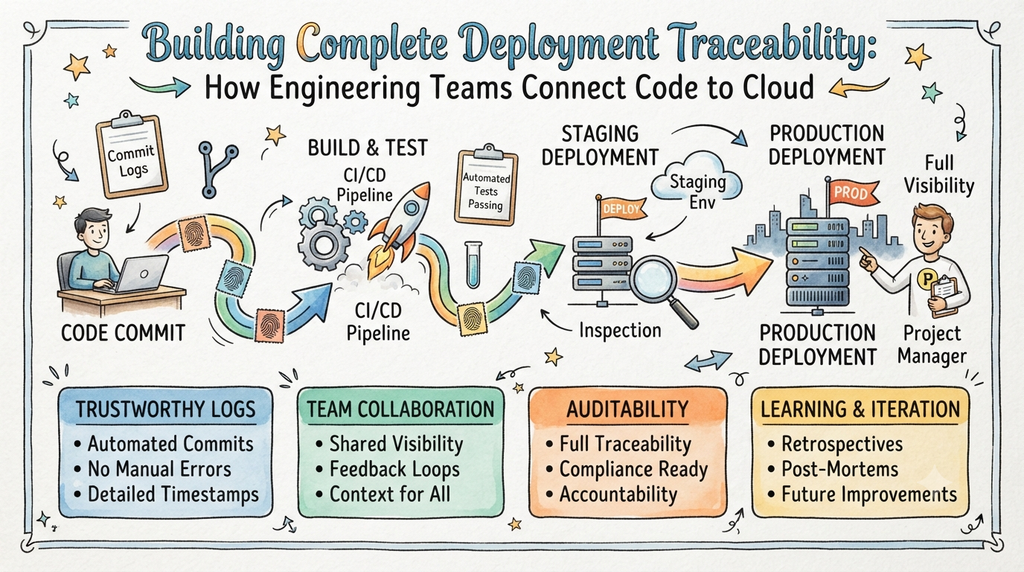
Watching how a single update moves through a connected pipeline shows why evidence links matter during daily engineering work. When a platform developer named Rohan ships a query optimization fix, every tool automatically forwards metadata to the next stage so anyone can trace the live container back to the original ticket:
- Issue Intake: Rohan claims ticket
CORE-418in Jira, which documents the database latency spike and affected checkout endpoints. - Branch Creation: Rohan opens branch
fix/CORE-418-query-indexin Bitbucket and submits a pull request linked directly to Jira. - Peer Review: A teammate inspects the diff, verifies passing integration tests, and submits a formal approval in Bitbucket.
- Artifact Packaging: The CI pipeline compiles the service, tags the container image
checkout-api:4.2.3, and stores its SHA-256 digest in the registry. - Cluster Rollout: ArgoCD deploys
checkout-api:4.2.3to the production cluster and logs the active digest alongsideCORE-418.
Four Pipeline Blind Spots That Erase Release Context
Fast-moving software teams ship updates across dozens of repositories, cloud accounts, and staging tiers every week. Because each delivery tool records only its own isolated events, vital context vanishes whenever teams take shortcuts under pressure:
- Detached Pull Requests: Developers merge branches without attaching a Jira or Linear ticket key, hiding the business reason behind the code edit.
- Reusable Container Labels: Build pipelines publish updated images under generic tags like
stagingorlatest, wiping out the link to the previous binary. - Direct Infrastructure Edits: Operators tweak live cluster settings manually during outages, bypassing automated CI/CD tracking logs completely.
- Force-Pushed Branch Histories: Contributors rewrite commits on active pull requests, destroying earlier code review discussions and approval trails.
Mapping Technical Proof Across Five Delivery Layers
Achieving a dependable software release audit trail requires capturing verified facts across five distinct stages of your software lifecycle. Merging a pull request only proves that code entered your repository, so teams must collect build outputs, package digests, and environment rollout logs to verify live delivery.
| Delivery Layer | Representative Tools | Audit Evidence Produced |
|---|---|---|
| Requirement Tracking | Jira, Linear, Azure Boards | Issue IDs, feature descriptions, and assigned owners. |
| Source Repositories | GitHub, GitLab, Bitbucket | Commit hashes, pull request diffs, peer approvals, and tags. |
| Build Pipelines | GitHub Actions, CircleCI, Jenkins | Build numbers, automated test outcomes, and timestamps. |
| Artifact Registries | AWS ECR, Artifactory, Docker Hub | Immutable version tags, binary checksums, and digests. |
| Runtime Infrastructure | Kubernetes, ArgoCD, Terraform | Target environment names, rollout timestamps, and digests. |
Four Engineering Habits That Keep Release Trails Intact
Organizations do not need to replace their existing developer platforms to maintain trustworthy release histories. Enforcing four practical habits ensures every software update carries verifiable proof from initial ticket creation to final production rollout:
- Mandate Ticket Keys in Branch Names: Configure repository checks that block merges unless the branch name or pull request title includes an active issue key.
- Assign Immutable Build Versions: Stamp every compiled artifact with a unique semantic version or commit SHA and forbid overwriting existing registry tags.
- Publish Structured Rollout Events: Update deployment workflows to record the exact artifact digest, target environment, and rollout timestamp upon completion.
- Revoke Direct Production Access: Remove manual SSH and console write privileges on live servers so every change flows through an auditable CI/CD pipeline.
Manual Release Checklists Versus Automated Intelligence
Tracking updates in shared spreadsheets works when a small team ships once a month, but manual logs collapse under daily microservice deployments. Switching to an automated CI/CD deployment tracking dashboard removes repetitive data entry while keeping your release records accurate.
| Evaluation Criteria | Manual Spreadsheet Logs | Automated Release Intelligence |
|---|---|---|
| Record Assembly | Engineers copy PR links and build numbers by hand. | Connectors ingest commits, builds, and deploys automatically. |
| Audit Preparation | Teams spend days gathering screenshots before reviews. | Systems maintain continuous, searchable release trails. |
| Data Accuracy | Typos and missed rows corrupt launch histories. | Reconciliation engines match exact digests to tickets. |
| Launch Visibility | Leads guess whether tests and approvals finished. | Confidence scores flag missing proof before rollout. |
Lightweight Guardrails for Safer Software Launches
Once your engineering tools share connected release evidence, technical leaders can apply sensible governance rules that protect production stability without slowing daily velocity:
- Set Release Readiness Thresholds: Require passing test suites, verified artifacts, and peer approvals before allowing any release candidate into production.
- Enforce Calendar Freeze Windows: Pause routine rollouts during peak business events while preserving a documented exception path for urgent security fixes.
- Lock Immutable Release Snapshots: Save a permanent, read-only record of all linked tickets, commits, and digests at launch time so later edits never alter history.
- Publish Audience-Specific Notes: Use an automated release notes generator to convert linked pull requests into clear updates for product, support, and executive teams.
Unifying Release Evidence With Reloqui
Maintaining custom scripts to connect webhooks across repositories, issue trackers, and cloud clusters creates heavy overhead for platform teams. Reloqui acts as a release intelligence platform that complements your existing tools rather than replacing source control or deployment pipelines. Through twelve native connector types—including GitHub, GitLab, Bitbucket, Azure DevOps, Jira, Linear, CI/CD systems, artifact registries, and Terraform—the platform gathers scattered delivery signals into one unified view. Its 11-stage release reconciliation engine links pull requests, issues, builds, artifacts, and deployments while calculating an explainable release confidence score from signals like Git tags, build status, artifact availability, orphaned changes, and force-push activity. Teams can also enforce publishing policies, manage release approval workflows, schedule freeze windows, lock immutable release snapshots, explore a no-login guided demo online, or run the free self-hosted platform with its complete feature set.
Frequently Asked Questions
How do freeze windows handle urgent security patches?
Freeze windows block routine deployments during sensitive business dates while providing an explicit exception workflow for critical fixes. Built-in approval rules record who authorized the emergency rollout and preserve every piece of supporting evidence for later review.
Why should engineering and business teams read different release notes?
Engineering release notes detail commit SHAs, schema migrations, and infrastructure changes for developers and operators. Business release notes translate those same linked tickets into plain-language summaries of new features and bug fixes for product and support teams.
When should a growing startup automate release tracking?
Startups gain the most value by automating release tracking as soon as multiple developers ship updates across several services or environments. Establishing clean links early avoids fragile spreadsheets and builds trustworthy audit records before enterprise customers demand them.
What makes a software release tracking tool effective for DevOps teams?
An effective software release tracking tool automatically reconciles commits, builds, artifacts, and deployments across all environments without demanding manual data entry. DevOps engineers gain immediate visibility into what changed, who approved it, and which version runs on every cluster.
Why does merging a pull request not prove live deployment?
Merging a pull request only places code inside your source repository branch. The update can still fail during compilation, stall in staging, or wait behind a deployment gate, so teams need rollout logs from target servers to verify live execution.
How do orphaned commits create risks during software audits?
Orphaned commits enter a release without a linked issue ticket or documented approval trail. Security reviewers and auditors cannot verify who requested those edits or why developers wrote them, creating compliance gaps that delay formal reviews.
Which signals determine a release confidence score?
A release confidence score evaluates whether a pending release contains complete technical proof, including linked issues, passing builds, available artifacts, and deployment records. It also flags risk indicators like unlinked pull requests or force-pushed branches before launch.
Can engineering teams adopt release intelligence without replacing existing tools?
Yes. Release intelligence platforms connect to your current repositories, issue trackers, and CI/CD pipelines via standard APIs and webhooks. Developers keep their familiar daily workflows while the platform compiles audit trails and readiness checks quietly in the background.
Why do immutable release snapshots protect compliance records?
Immutable snapshots freeze your release metadata at the exact moment a deployment finishes. Even if someone edits an old Jira ticket, deletes a feature branch, or purges CI logs months later, the snapshot preserves the exact facts from launch day.
How do mutable container tags break deployment tracking?
Mutable tags like latest overwrite previous image pointers every time a build job finishes. When an issue appears in production, engineers cannot tell which specific commit built the running container or safely revert to the prior version.
Final Thought
Establishing reliable software release tracking practices turns chaotic launch days into calm, transparent engineering routines. When your repositories, issue trackers, build pipelines, and runtime clusters share connected proof, every team member sees exactly what shipped and why. Start by requiring ticket keys on pull requests, publishing immutable build tags, and logging live deployment digests across every environment. Pairing these disciplined habits with automated release intelligence keeps your records complete, speeds up incident recovery, and gives your organization genuine confidence in every deployment.